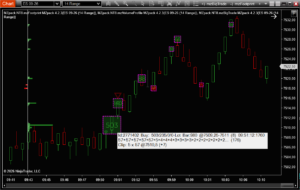
Combining both dividing and merging TPO profiles offers a comprehensive way to analyze market structure across multiple time frames, allowing traders to spot both macro and micro market dynamics. Here are the benefits of utilizing both techniques:
1. Broad and Granular Market Insights
- Merging profiles provides a macro view, showing the big picture of market behavior over multiple sessions or days. You get to see long-term trends, key support/resistance levels, and the overall market sentiment.
- Dividing profiles, on the other hand, helps in dissecting the market into smaller chunks, offering a micro view of intraday activity, session-specific movements, and short-term trends.
2. Enhanced Trend Identification
- Merging allows you to identify major trends by smoothing out short-term fluctuations and noise. You can track how price behaves over a week or a series of trading days, identifying the overall market direction.
- Dividing reveals intraday or session-specific trends, helping you understand the market’s behavior within smaller time periods. For example, how price moves during the European session versus the U.S. session.
Benefit: You can align your trades with the broader market trend (from merged profiles) while timing your entries based on the short-term trend shifts (from divided profiles).
3. Locating Long-Term Value and Intraday Volatility
- Merging multiple sessions helps pinpoint areas of long-term value, such as major Points of Control (POCs) or value areas where price has repeatedly balanced.
- Dividing profiles helps capture intraday volatility, such as the opening range, midday reversals, or the behavior of different global market sessions.
Benefit: This approach helps you identify whether current price action is occurring near an area of long-term value, and whether the short-term volatility presents trading opportunities around those zones.
4. Finding Major Support/Resistance and Micro-Level Turning Points
- Merged profiles show where the market has repeatedly found support or resistance across multiple sessions. These levels are crucial as they attract both long-term institutional players and retail traders.
- Divided profiles allow you to see minor support and resistance levels within the day, which are critical for short-term traders looking to scalp or catch intraday moves.
Benefit: You get to act on key long-term support/resistance levels while reacting to micro-trends within the day.
5. Confirming Breakouts
- Merging helps you track whether a breakout from a key level is significant based on its alignment with longer-term price action.
- Dividing profiles lets you see how price behaves just before and after a breakout, providing insights into the short-term volatility and confirmation of whether the breakout will sustain.
Benefit: You can filter out false breakouts by cross-referencing the broader market structure with short-term price reactions.
6. Efficient Trade Planning
- Merging lets you set broader targets and stops by identifying large value areas or major POCs that may act as magnets for price.
- Dividing helps you refine those targets based on intraday volatility, allowing for tighter stop-losses and more precise profit-taking.
Benefit: Merged profiles offer a roadmap for longer-term trades, while divided profiles provide finer control for intraday trades, reducing risk and enhancing reward potential.
7. Volume and Time Dynamics
- Merging profiles highlights where heavy volume or time was spent in price discovery over a larger timeframe, giving you insight into where larger players are interested.
- Dividing profiles shows how volume and price interact in shorter timeframes, helping you identify if there is a shift in sentiment during specific periods (e.g., morning session vs. afternoon session).
Benefit: By combining both, you understand where long-term participants are focused and where short-term shifts may present trading opportunities.
8. Balancing Macro and Micro Strategy
- Merging is useful for swing traders or position traders who need to track longer trends and hold trades over several days.
- Dividing is helpful for day traders who focus on capturing short-term price movements within the day.
Benefit: By applying both techniques, you can switch between macro and micro strategies, depending on market conditions. For example, you may hold a position based on a weekly trend (merged profiles) while trading around that position based on intraday fluctuations (divided profiles).
9. Contextualizing Market Sentiment
- Merging profiles shows the broader market sentiment—whether the market is in a range, trending, or finding balance across multiple sessions.
- Dividing profiles shows changes in sentiment within the day, especially how traders are responding to news, data releases, or major events.
Benefit: You can adapt your trading plan based on whether the intraday sentiment (divided) aligns with or contradicts the broader market sentiment (merged).
10. Maximizing Trade Timing
- Merging helps you know when to take bigger swing trades, holding positions for days or weeks as price interacts with major value areas.
- Dividing helps you catch precise entries/exits within these broader moves by identifying periods of short-term price rejection, value shifts, or volume spikes.
Benefit: Combining both allows you to optimize your timing for both entering swing trades and managing intraday trades, maximizing your potential for profit.
Conclusion:
By using both dividing and merging TPO profiles, you can gain a comprehensive view of the market’s structure, capturing both the bigger picture and short-term fluctuations. This dual approach improves your ability to time trades, manage risk, and identify key price levels, whether you’re swing trading over multiple days or day trading within the same session. It allows you to adapt your strategy to different market conditions and capitalize on both long-term trends and short-term opportunities.
Related Products:
TPO profiles are available in mzVolumeProfile indicator for NinjaTrader.